Play Moto X3M
Set your speed before the front wheel reaches the ramp. Once the bike is airborne, use the balance controls to line it up with the landing instead of trying to fix the whole approach mid-jump.
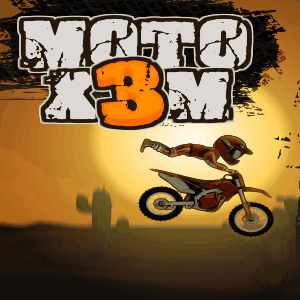
Press Play to load · Keyboard recommended
The game loads when you press Play. Loading help ↗
🏍️ Four keys, three kinds of control
| Input | Action | Why it matters |
|---|---|---|
| Up arrow | Accelerate | Sets how quickly you reach a ramp or moving hazard. |
| Down arrow | Brake | Lets you change the approach before the obstacle. |
| Left / Right arrows | Balance the bike | Changes the bike’s angle, including during a jump. |
| Game’s restart control | Retry a level or checkpoint as offered | Use the loaded prompt rather than assuming a universal restart key. |
🧭 Break a jump into approach, flight and landing
Choose enough speed for the obstacle without making the next part unreadable.
Use balance inputs deliberately. Extra rotation needs time and landing room.
Bring the bike toward a stable angle and inspect what follows the wheels.
⏱️ Checkpoints change the value of a retry
A checkpoint lets you revisit a section without beginning the whole game again. That is useful for learning a ramp, but a repeated crash can still make a timed attempt less effective. Separate a learning run from a clean completion attempt so the result is easier to judge.
On a learning run, inspect how the obstacle behaves and test one approach speed. On a clean run, use what you learned rather than adding an unfamiliar stunt because the previous section went well. A safe-looking flight can still end in a poor landing if the rotation lasts too long.
🖼️ Read the track as a sequence
Think beyond the ramp
A ramp is the start of a movement, not the whole event. Look at the height and direction of the landing, then the next piece of track. A fast takeoff may be unnecessary if it leaves little time to settle before another hazard.
Flips can belong in a score or time strategy when the game rewards them, but learn a stable plain landing first. A trick is useful only when the whole section still works.
🎯 A one-section practice plan
Ride the section without a stunt
Find a baseline approach that reaches a manageable landing.
Change only the approach speed
Notice whether the bike arrives too high, too low or at a poor angle.
Add rotation only with room
Keep the landing as the priority. If a trick removes that margin, return to the plain route.
Compare like attempts
Use the same level and goal. A checkpoint experiment is not directly comparable with a complete clean level.
🛷 Leave the automatic-speed habit behind
In Snow Rider, you mainly choose a lateral line and a jump. Moto X3M also lets you change the arrival speed and bike orientation. Holding full throttle because the sled always moves forward misses one of the bike game’s most useful tools.
If you want continuous forward movement with a smaller control set, Slope or Electron Dash may fit better. If the bike game does not start, use the player startup guide rather than installing an old plugin.
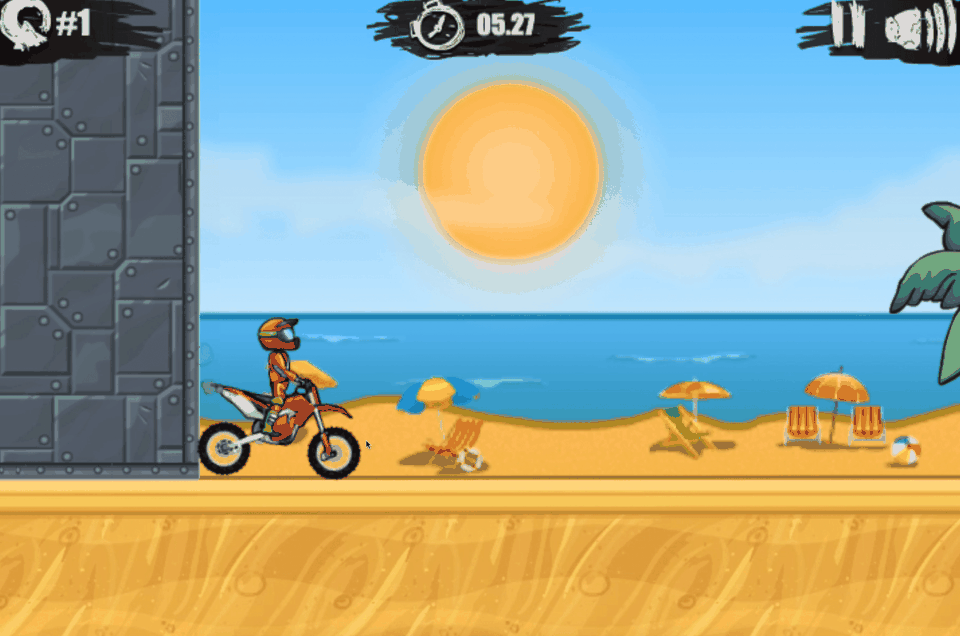
📸 An approach on the beach track