Snow Rider 3D Jump Timing
Before you jump, pick a patch of snow where the sled can land and keep moving. If that patch disappears behind another obstacle, change your approach while you still have room to steer.
🪂 Think from the landing backward
Begin with the exit
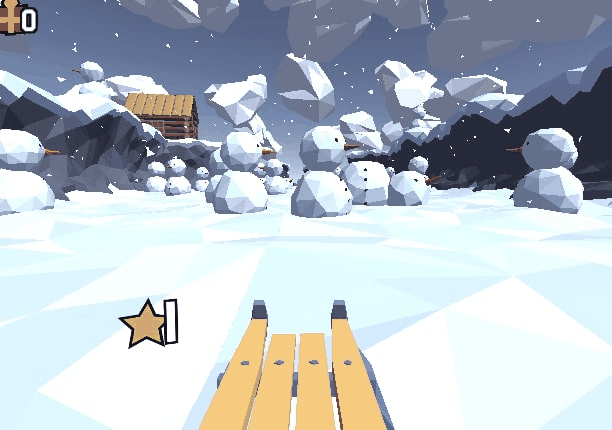
Before takeoff, find the patch of snow you expect to reach and the direction you could leave it. If a tree or a snowman fills that exit, clearing the first obstacle is not enough.
This is why a spectacular-looking jump can be a poor choice. The flight may be clean while the next decision is already lost. A plain side route with room to adjust is often the more useful line.
Is there usable space beyond the obstacle?
Can you reach that line without a sharp reversal?
Is jumping still the simplest way through?
👀 Use a repeatable cue, not a guessed timer
There is no universal number of milliseconds that makes every Snow Rider 3D jump correct. The apparent size of an obstacle changes as it approaches, and different displays alter how far away it looks. Use the shape’s approach and your available landing space as cues.
To learn a cue, choose ordinary, readable situations. Make one jump, watch where it lands and adjust the next attempt slightly. If every experiment starts beside a different hazard, you cannot tell whether the timing or the route caused the crash.
⚖️ Jump or steer?
| Situation | Decision worth considering | Reason |
|---|---|---|
| A wide open route around the hazard | Steer early | It keeps the landing problem out of the decision. |
| A crossing with a clear far side | Line up, then jump | The destination is readable before you commit. |
| An obstacle hiding the area beyond | Look for another passage | An unseen landing adds uncertainty. |
| A gift above an awkward line | Leave the gift | A collectible is optional; a usable exit is not. |
🎯 The landing-first drill
Ignore the presents
For one attempt, treat every gift as scenery. You are removing an extra reason to change direction.
Name the landing space
Before each planned jump, identify a left, middle or right exit in your own words. If you cannot identify one, reconsider the jump.
Review the first failed landing
Ask whether you took off too early, too late or from a poor line. Those are different problems and need different changes.